
Bollards vs Road Blockers: Differences, Types and Applications
Bollards vs Road Blockers: Differences, Types and Applications
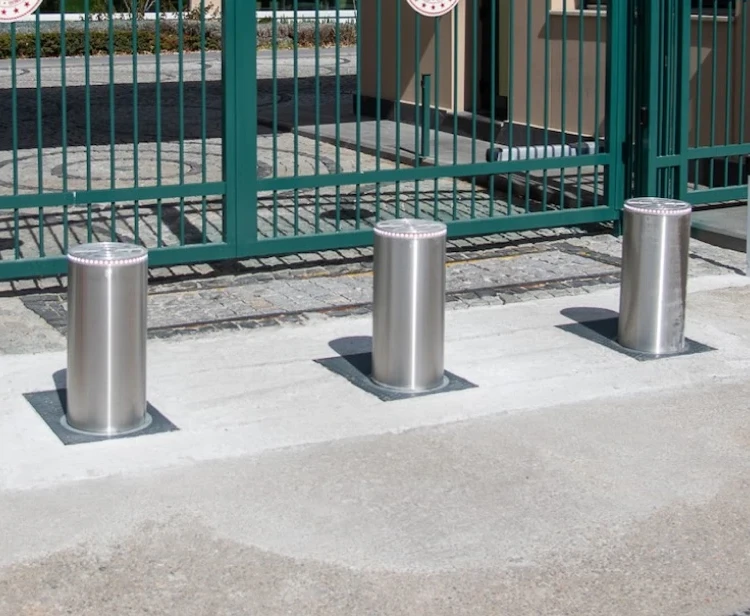
What is a Bollard?
A bollard is a physical security barrier in a cylindrical structure that rises from the ground. It is used to direct vehicle traffic, protect pedestrian zones, and prevent unauthorized vehicle entry. It is commonly seen in city centers, government institutions, airports, and commercial districts.
Bollards are categorized into three main groups based on their operating mechanism: hydraulic, electromechanical, and fixed (static).
What is a Road Blocker?
A road blocker is a wide-surfaced steel barrier system that rises from ground level. Unlike a bollard, it has the structural strength to completely stop a heavy vehicle. Models certified under international crash tests, such as K12, can withstand the impact of a 7,500 kg vehicle traveling at 80 km/h.
They are deployed in high-security sites such as military facilities, airports, embassies, government buildings, and power plants.
Differences Between Bollards and Road Blockers
While both systems control vehicle access, they show significant differences in protection level, dimensions, installation requirements, and cost:
- Protection Level: Bollards provide a medium-level physical obstacle, whereas road blockers offer K12-certified high impact resistance.
- Dimensions: Bollards feature a cylindrical structure with a diameter of 219–323 mm. Road blockers consist of a wide steel panel 3 meters wide and 800 mm high.
- Installation: Bollards require single-point excavation (800–1500 mm depth). Road blockers require a large foundation pit (1600 mm depth, 3220 mm width).
- Intended Use: Bollards are used for traffic management and perimeter security, while road blockers serve as active defense against vehicle ramming attacks.
Types of Bollards
Hydraulic Bollard
Operating with an integrated hydraulic power unit, these models raise and lower automatically. The KRC BLD 600 Series is used in city centers with an opening speed of 2–3 seconds, while the KRC BLD-CT Series is deployed at airports and critical infrastructure with an impact energy absorption capacity of 2,000,000 Joules.
Fixed Bollard
Models without moving parts that create a permanent physical barrier. The KRC BLDF-CT Series features a shallow mount design that delivers high impact resistance with its ST37 steel body without requiring deep excavation. It is preferred for protecting parking lot perimeters, pedestrian zones, and green spaces.
Types of Road Blockers
Standard Road Blocker (RBL)
A heavy-duty steel road blocker engineered with computer-aided design to meet K12 protection standards. It has passed crash tests involving a 7,500 kg vehicle at 80 km/h and weighs between 1500–1800 kg.
Crash-Tested Road Blocker (RBL-CT)
A certified crash-tested model meeting K12 / DOS SD-STD-02.01 standards. During a vehicle attack, it disables the vehicle by destroying its wheels, front end, and undercarriage.
Shallow Mount Road Blocker (RBL-SL)
A model requiring an excavation depth of only 400 mm. It is designed for locations where deep excavation is not possible due to subterranean site conditions. Full raising and lowering cycles are completed in 3–4 seconds.
How to Choose the Right Product?
Answer the following questions when making your selection:
- What is the threat level? Traffic direction → bollard. Risk of vehicle ramming attack → road blocker.
- How frequent is the traffic? High traffic → hydraulic bollard (2–3 sec opening). Low traffic → fixed bollard.
- What are the ground conditions? If deep excavation is not possible → BLDF-CT fixed bollard or RBL-SL shallow mount road blocker.
- Budget and maintenance capabilities? Fixed models require no maintenance. Hydraulic models require periodic maintenance.
Related Products
Frequently Asked Questions
If you haven't found the answers to your questions, please contact us.
Contact